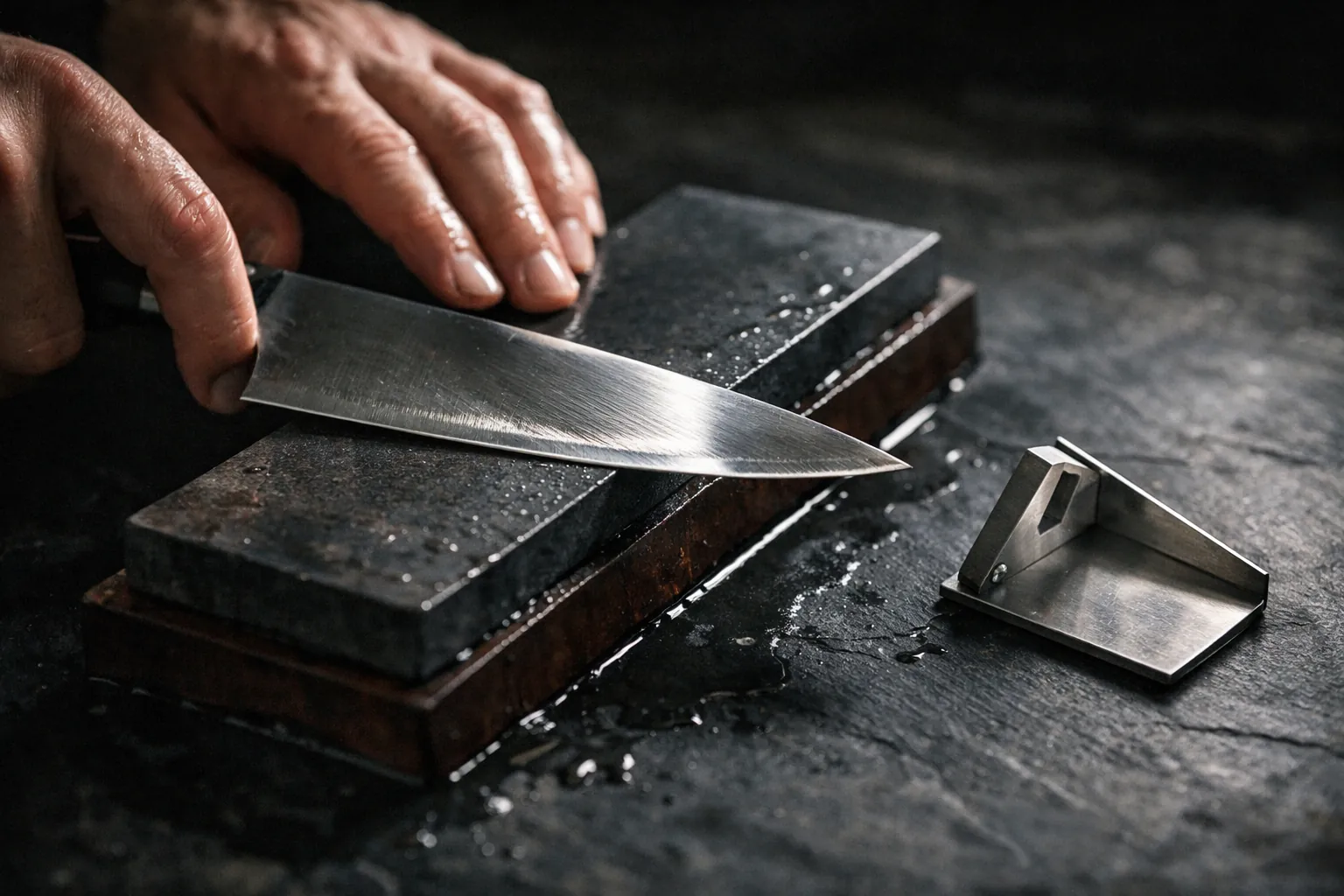
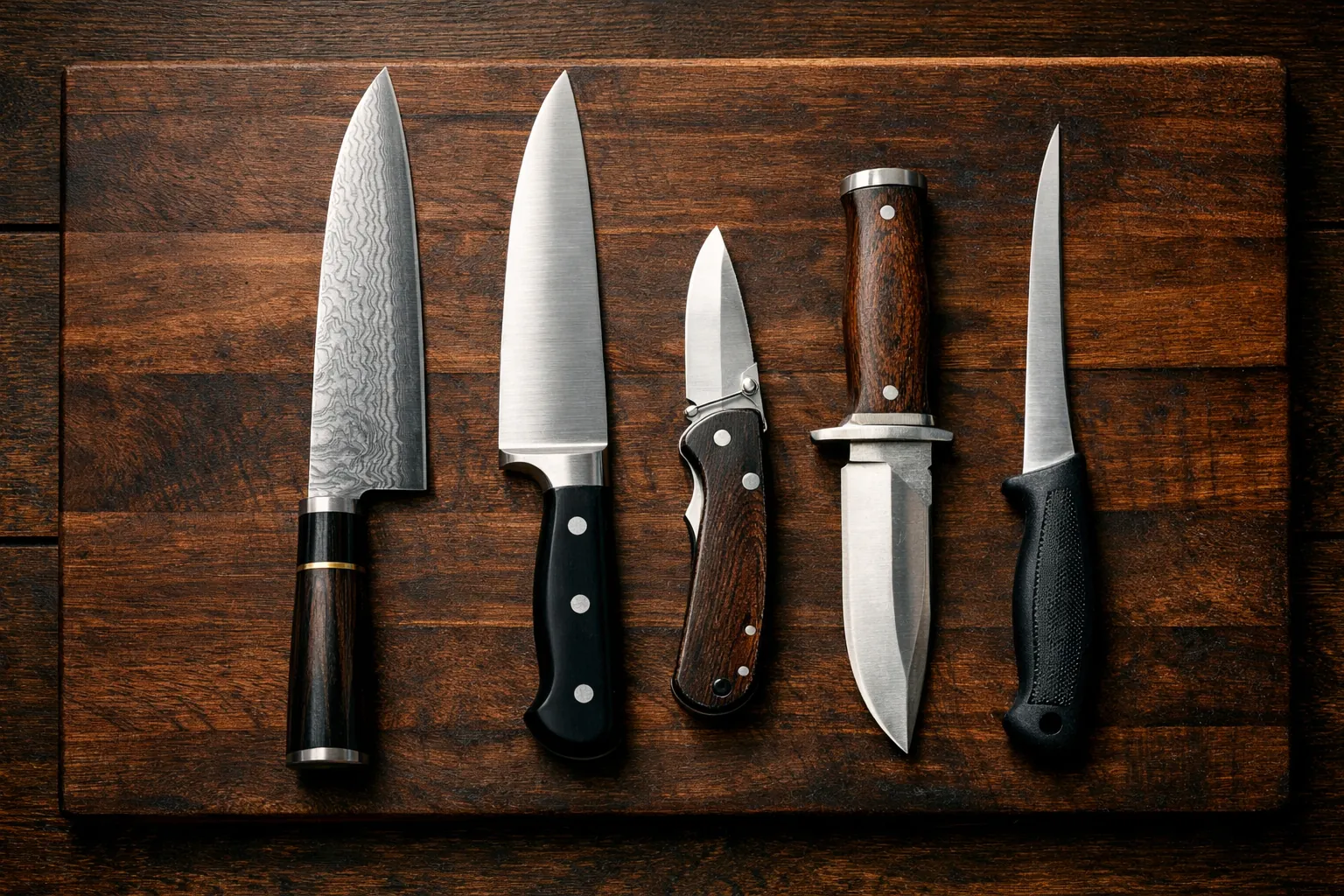
Most kitchen knives are sharpened between 15 and 20 degrees per side: many Japanese knives around 15° (some lower), many Western and German knives around 20°. Pocket and hunting knives usually sit around 20 to 25°, and choppers like cleavers higher still. These are common starting points, so always check your knife maker's recommendation and, when unsure, match the bevel that's already there.
Knife sharpening angle chart
Angles are per side unless noted. The ranges reflect common, well-established practice; individual makers vary.
| Knife type | Common angle per side | Inclusive (total) | Notes |
|---|---|---|---|
| Japanese kitchen (gyuto, santoku, petty, nakiri) | About 12°–15° | 24°–30° | Hard, thin steel supports a fine edge. Many makers quote around 15°. |
| Japanese single-bevel (yanagiba, deba, usuba) | Bevel on one side only | Varies | Follow the existing bevel; the flat back is only polished, not beveled. |
| Western / German chef's knife | About 20° | 40° | Traditional German edge. Some newer lines are closer to 15°, so check the maker. |
| Paring and utility knives | About 15°–20° | 30°–40° | Match the rest of your set. |
| Fillet and boning knives | About 12°–18° | 24°–36° | Thin, flexible blades for clean slicing. |
| Serrated (bread) knives | Follow the scallops' bevel | — | Usually beveled on one side; sharpen each scallop with a tapered rod. |
| Pocket / EDC knives | About 17°–25° (often ~20°) | 34°–50° | Lower for slicing, higher for rough use. |
| Hunting and outdoor knives | About 20°–25° | 40°–50° | Durability matters more than ultimate sharpness. |
| Cleavers, machetes, axes | About 25°–30° or more | 50°–60°+ | Chopping tools need a thick, strong edge. |
Starting points from standard sharpening practice, not maker specifications. Check your knife maker's recommendation first.
Per side vs inclusive: the confusion that ruins edges
An edge has two bevels. The per-side angle is measured from the center line of the blade to one bevel. The inclusive angle is the total of both sides. A "20-degree knife" almost always means 20° per side, or 40° inclusive.
Why it matters: if you set a tool to 40° thinking it's the total when it's actually per side, you'll grind a blunt 80° wedge. Read your sharpener's manual to see which convention it uses.
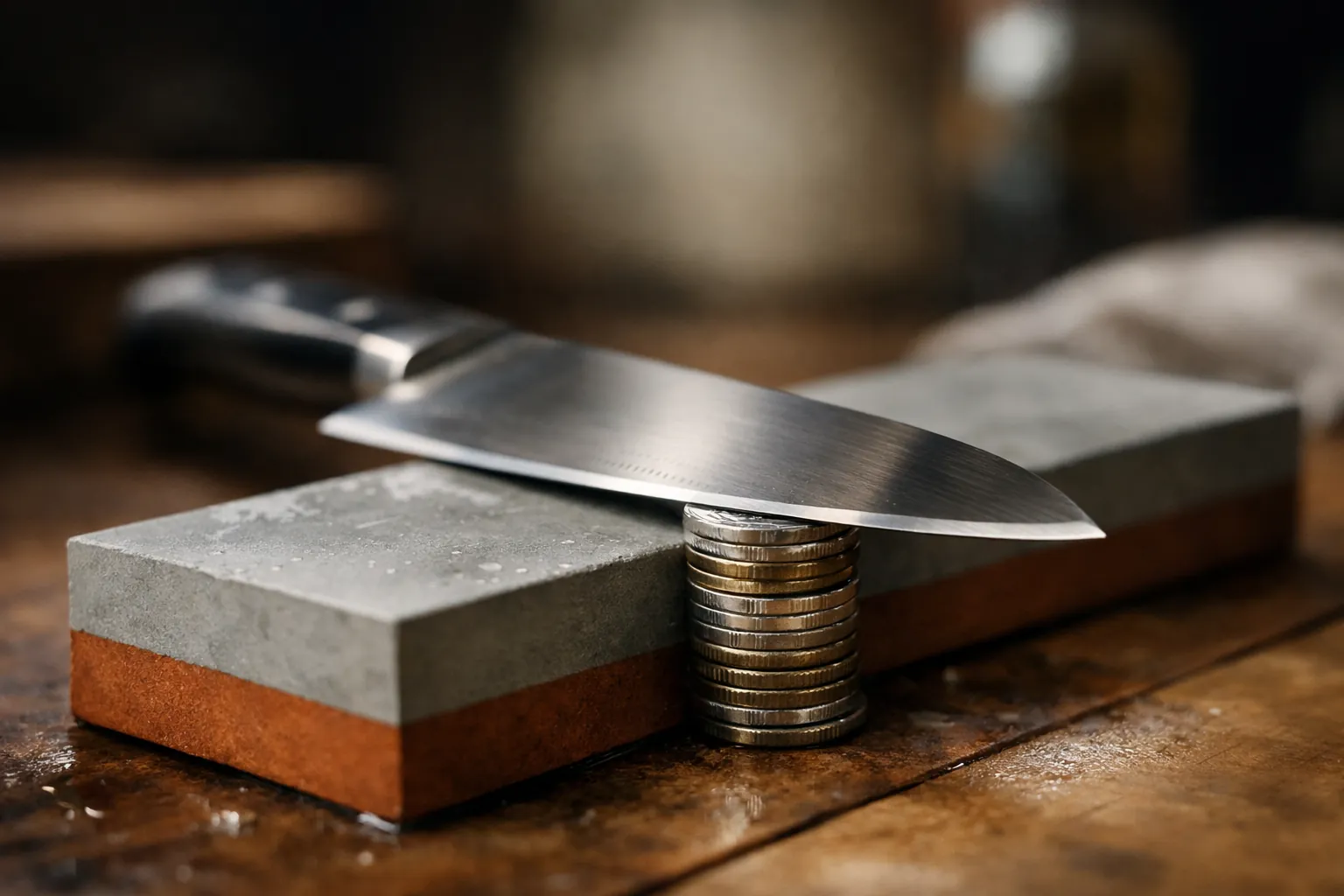
Spine-height table: see the angle on a whetstone
Freehand, you can't see 15°, but you can see how high the spine sits above the stone. The height is simple trigonometry: spine height = blade width × sin(angle), where blade width is measured from edge to spine at the point touching the stone. Find your blade's width, read across to your angle, and raise the spine that much.
| Blade width (edge to spine) | 12° | 15° | 17° | 20° | 25° | 30° |
|---|---|---|---|---|---|---|
| 1 in (25 mm), paring / pocket | 0.21 in / 5 mm | 0.26 in / 6.5 mm | 0.29 in / 7 mm | 0.34 in / 8.5 mm | 0.42 in / 10.5 mm | 0.50 in / 12.5 mm |
| 1.25 in (32 mm), utility / hunting | 0.26 in / 6.5 mm | 0.32 in / 8 mm | 0.37 in / 9.5 mm | 0.43 in / 11 mm | 0.53 in / 13.5 mm | 0.62 in / 16 mm |
| 1.5 in (38 mm), petty / boning | 0.31 in / 8 mm | 0.39 in / 10 mm | 0.44 in / 11 mm | 0.51 in / 13 mm | 0.63 in / 16 mm | 0.75 in / 19 mm |
| 1.75 in (44 mm), santoku | 0.36 in / 9 mm | 0.45 in / 11.5 mm | 0.51 in / 13 mm | 0.60 in / 15 mm | 0.74 in / 18.5 mm | 0.87 in / 22 mm |
| 2 in (50 mm), chef's knife | 0.42 in / 10.5 mm | 0.52 in / 13 mm | 0.58 in / 14.5 mm | 0.68 in / 17 mm | 0.85 in / 21 mm | 1.00 in / 25 mm |
Calculated values, rounded. Blade width changes toward the tip, so the spine drops slightly as you sharpen toward it to keep the same angle.
The marker trick: find the angle your knife already has
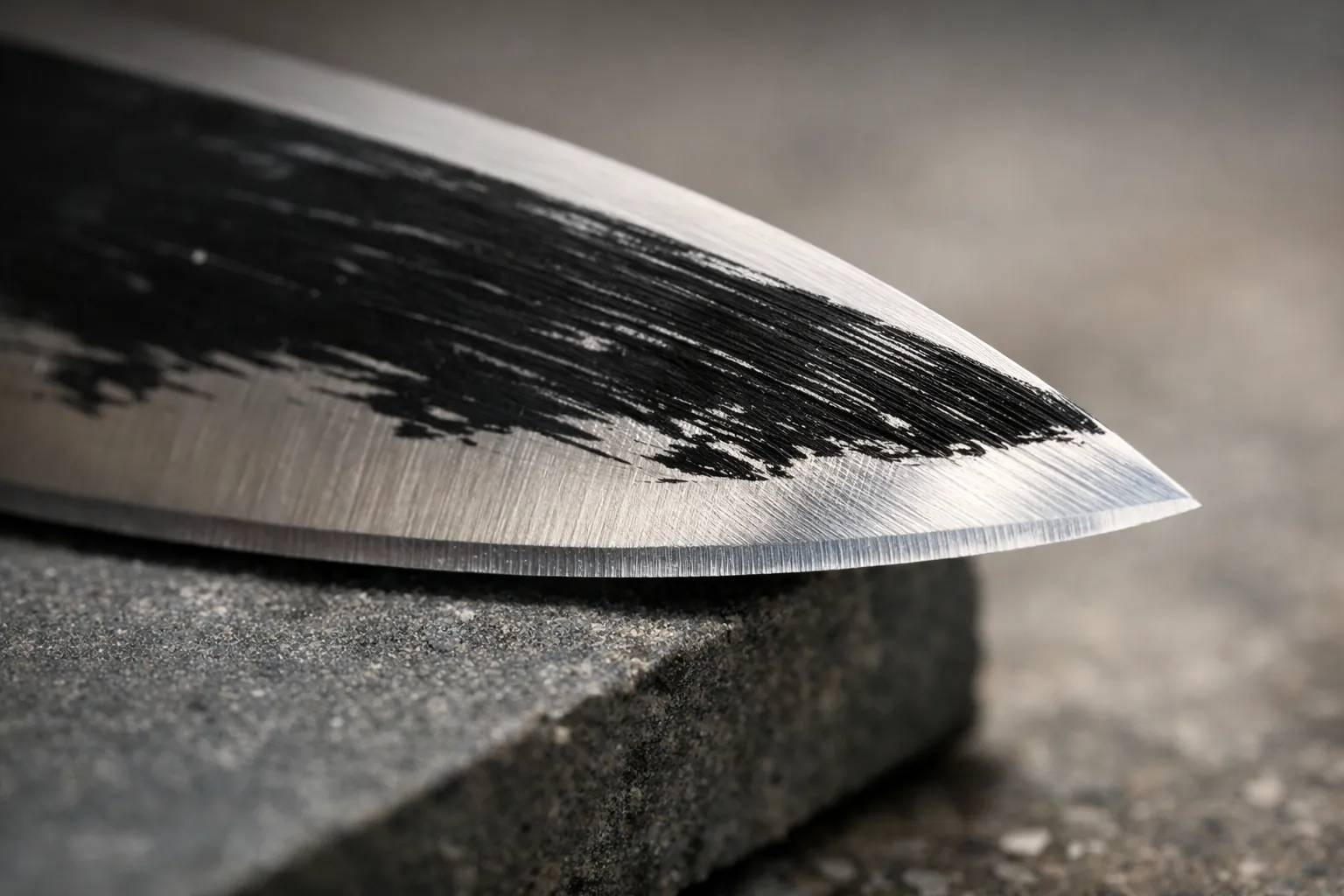
The safest angle is usually the one the factory put on. To find it, color the bevel with a permanent marker, set the knife on the stone at your best guess, and make one light stroke.
- Ink gone only at the very edge: your angle is too high. Lower the spine.
- Ink gone only at the top of the bevel: your angle is too low. Raise the spine.
- Ink gone evenly across the bevel: you've matched it.
Choosing between a lower and a higher angle
A lower angle cuts more easily but chips or rolls sooner; a higher angle is tougher but feels less keen. Three things should push you one way or the other:
- The steel. Hard steels (common in Japanese knives) hold a thin edge; softer stainless steels (common in Western knives) often roll at very low angles.
- The job. Slicing fish or vegetables favors a lower angle; breaking down chicken, cutting rope or batoning wood favors a higher one.
- Your board and habits. If you scrape food across the board with the edge or use glass boards, a slightly higher angle survives longer.
A common trick is a micro-bevel: sharpen at your main angle, then add a few light strokes 2 to 5 degrees higher on a fine stone. It adds strength right at the apex without thickening the whole edge.
Tools that hold the angle for you
If holding an angle freehand is the problem, let a tool do it:
- Clip-on whetstone angle guides such as the SHARPAL 194H angle guide clip to the spine and set a fixed height while you learn.
- Guided systems such as the Work Sharp Precision Adjust clamp the knife and dial in any angle from 15° to 30°.
- Clamp-and-rod kits like the Lansky Deluxe 5-stone system use preset angle holes in the clamp.
- Electric sharpeners like the Chef'sChoice 15XV are fixed at one angle (15° on that model).
Compare them in our best sharpening system guide, or learn freehand with how to use a whetstone. Once you've set the angle, the grit chart tells you which stones to use.
The bottom line
Start at around 15° per side for Japanese kitchen knives, around 20° for German and Western knives and pocket knives, and 20 to 25° for hunting knives, then adjust to your maker's recommendation and how you use the knife. Whatever angle you choose, consistency matters more than the number: a steady 20° beats a wobbly 15° every time.
Angle ranges reflect standard sharpening practice and published maker guidance as of October 3, 2026; spine heights are calculated. Product details come from Amazon listings checked the same day. How we research · Affiliate disclosure