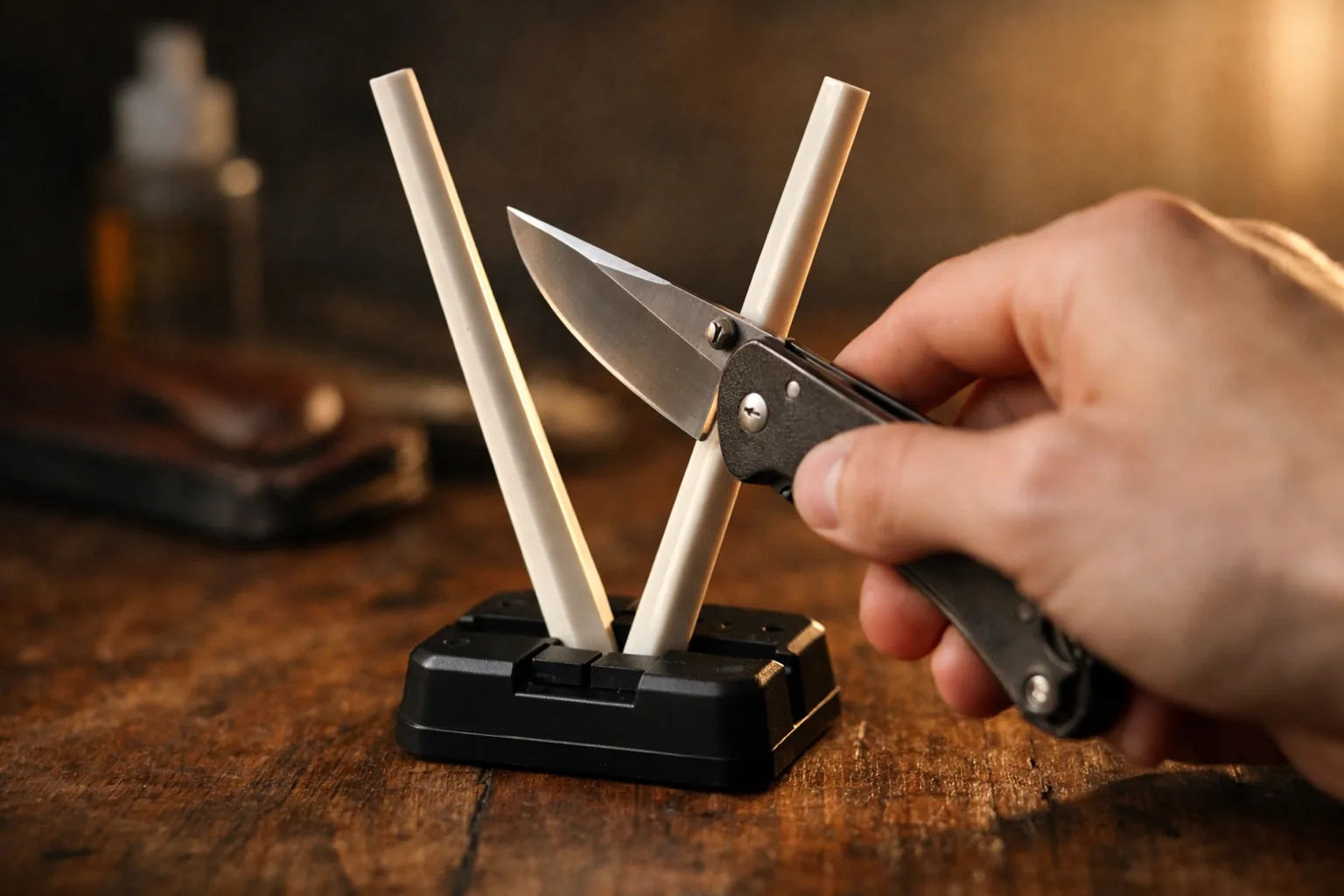
Buy the Spyderco Sharpmaker if your knives are already decent and you want to keep them that way, serrated ones included. It has two fixed angles (15° and 20° per side) and ceramic stones, and the only skill it asks of you is holding the blade upright. Skip it if your knives are very dull or chipped, or need some other angle. The diamond stones fix the first problem. Nothing fixes the second.
Quick picks
| Best for easy maintenance | Spyderco Tri-Angle Sharpmaker (204MF) | Amazon |
|---|---|---|
| Best add-on for dull knives | Sharpmaker diamond stones (pair) | Amazon |
How we evaluated it
We read the Sharpmaker's listing and Spyderco's published instructions, then set them against the other popular guided sharpeners and what owners say about them. On October 3, 2026, the main Amazon listing showed more than 5,000 ratings and 50+ purchases in the past month. Spyderco lists a two-year warranty.
We haven't run a sharpening lab on it. This review comes from the maker's specs and instructions plus owner feedback, checked against standard sharpening knowledge. How we research.
How the Sharpmaker works
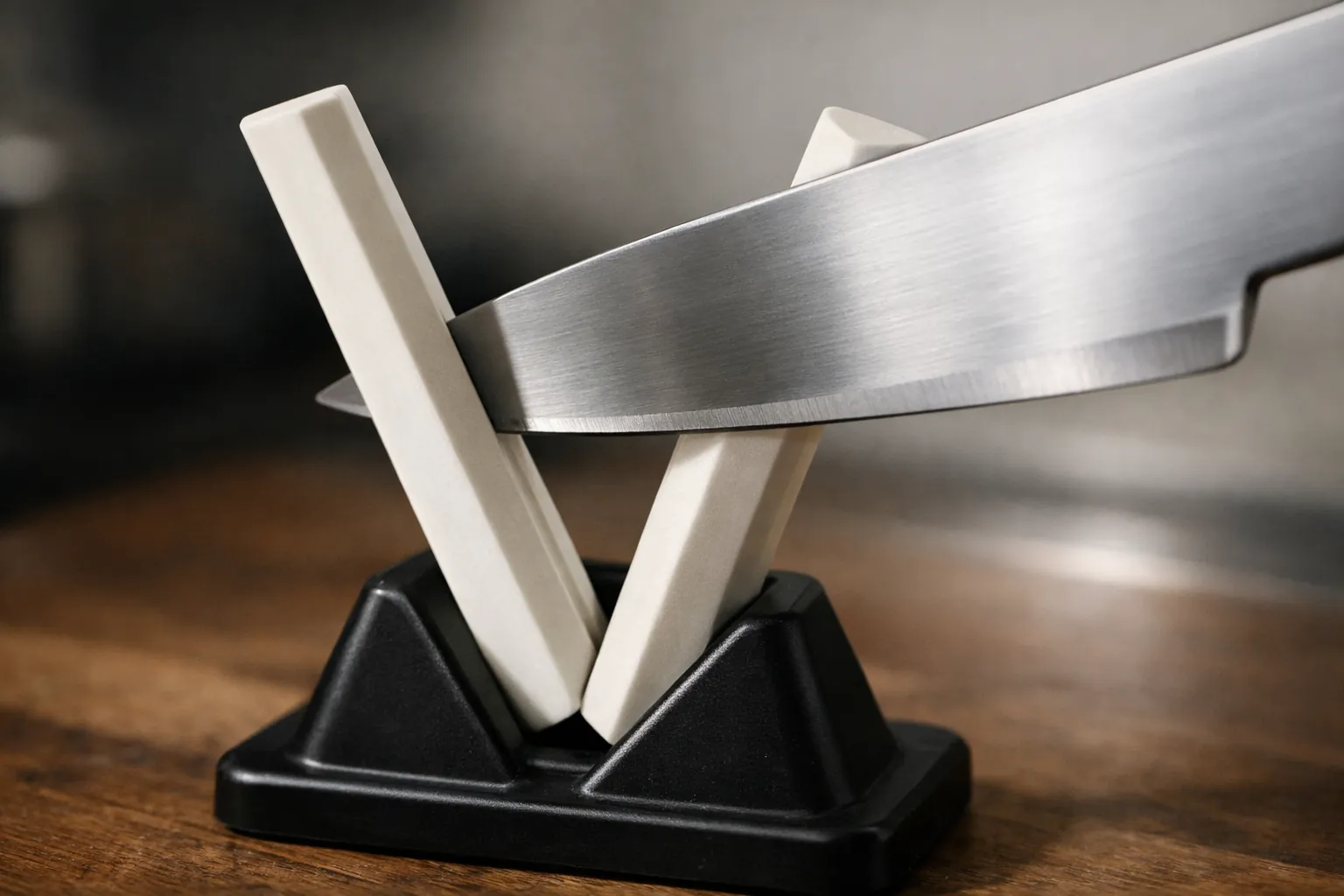
Keyed holes in the base hold two triangular stones in a V. Hold the knife straight up and down, draw it down one stone from heel to tip, then down the other. The stones already sit at the angle, so your only job is keeping the blade vertical. Most people do that without thinking.
Spyderco's routine is to sharpen on the 40° setting, corners first and then flats, roughly 20 to 30 strokes per side on each. About every tenth sharpening, switch to 30° and thin the area behind the edge (a back bevel). That keeps the 40° edge small, so it resharpens quickly.
The Sharpmaker and the add-ons worth buying
Spyderco Tri-Angle Sharpmaker (204MF)
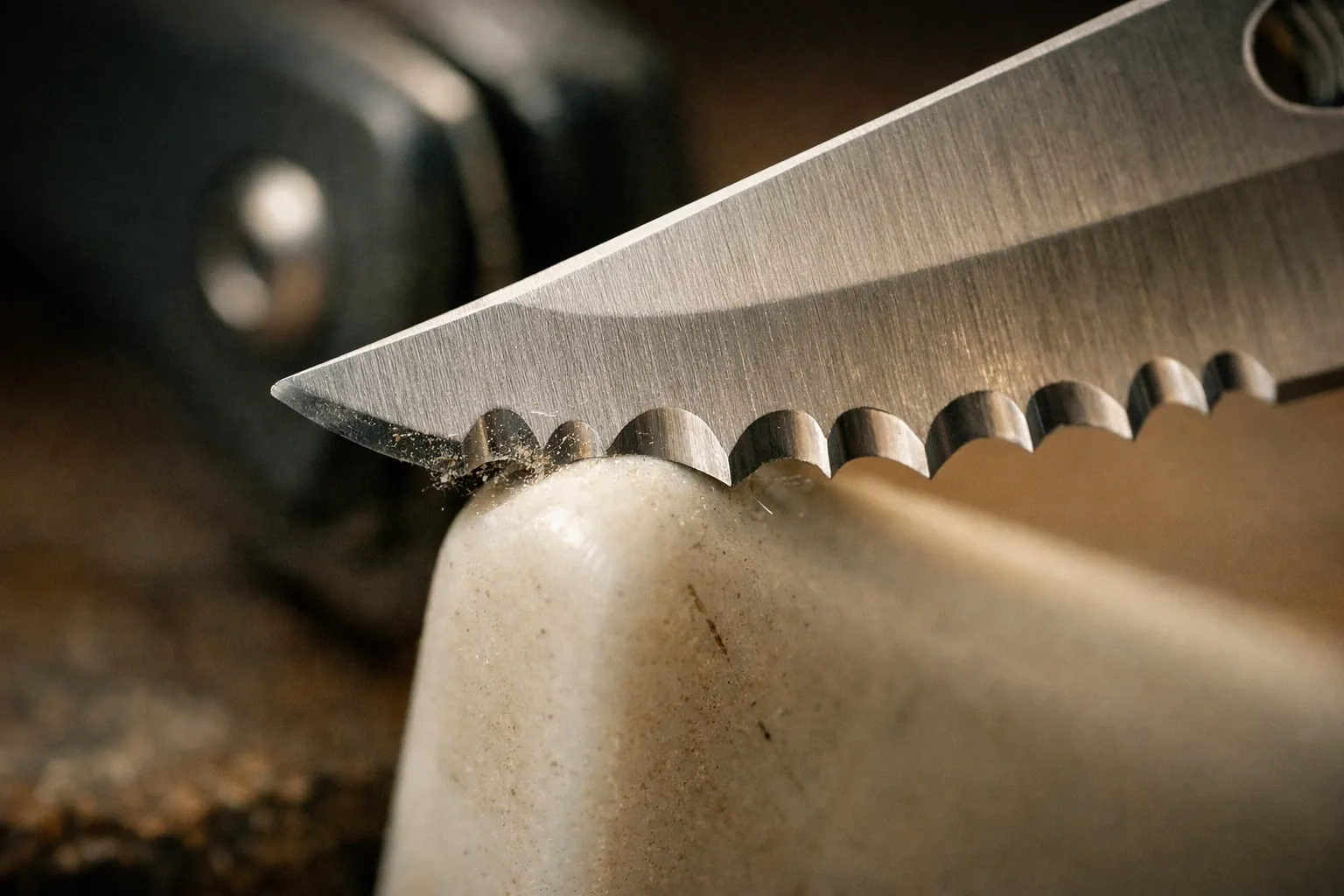
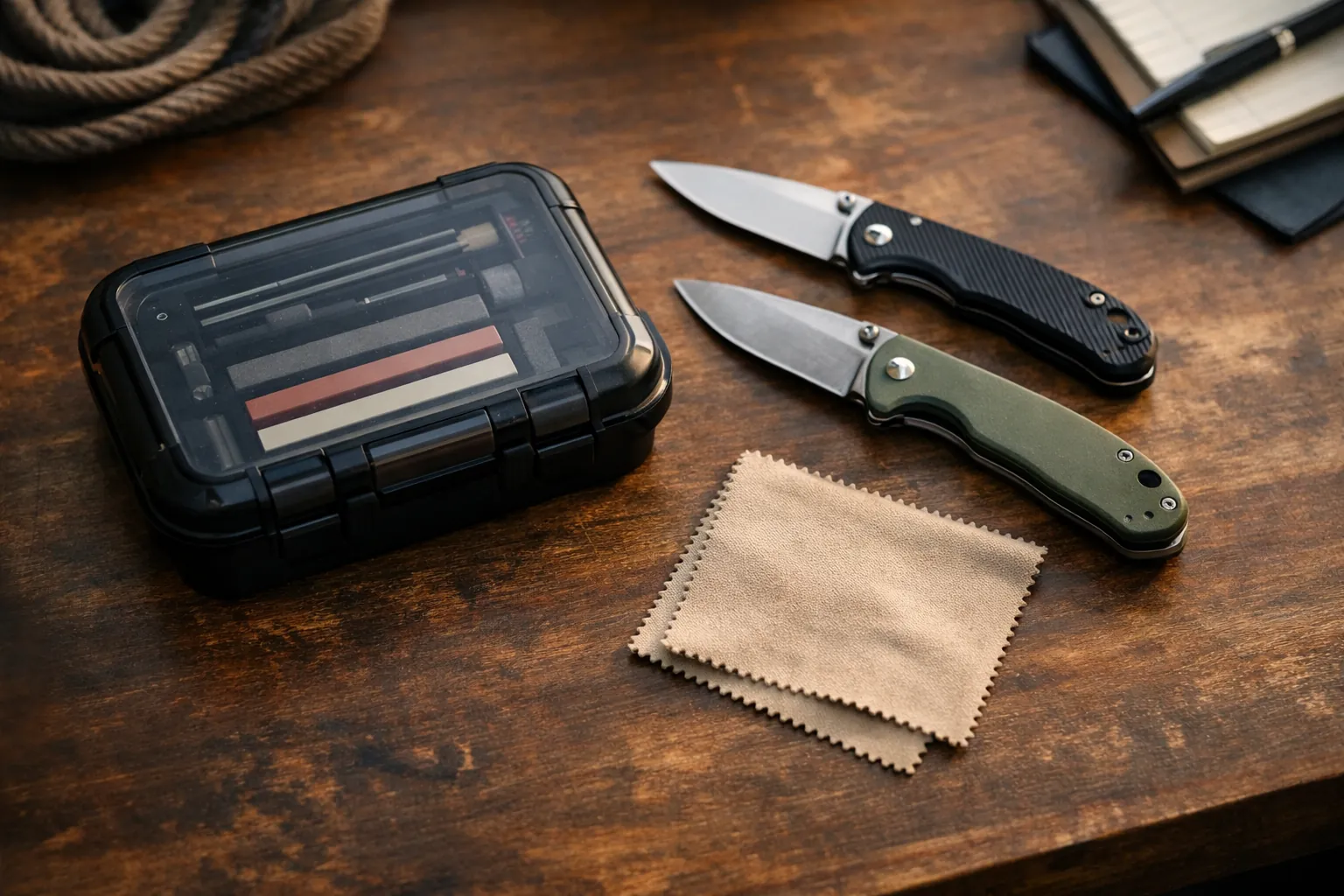
Two pairs of alumina ceramic stones come in the box: medium brown for sharpening, fine white for finishing. The rounded edges of the triangles reach into serrations, so a serrated knife gets the same strokes as a plain one. Aluminum safety rods slot into the base to keep your hand clear, and the whole kit packs into the base and lid. Lay the stones flat in the base and they double as small bench hones.
Think of it as a maintenance tool. Ceramic cuts slowly. A knife that's merely dull comes back quickly, while a chipped edge or a thick factory bevel you want to change will take a long time on the stock stones.
- Angles30° and 40° inclusive (15°/20° per side)
- Stonesmedium (brown) and fine (white) alumina ceramic
- Edgesplain and serrated
- Extrasaluminum safety rods, scissor setting, storage base and lid
- Warranty2 years
Why it stands out
- Easiest guided system to learn: keep the blade vertical, nothing else
- Handles serrated edges well
- Compact, no clamps, no oil or water
- 5,000+ owner ratings
Think twice if
- Your knives are very dull or chipped and you won't buy the diamond stones
- You need angles other than 15° or 20° per side
- You want a mirror polish without extra stones
Sharpmaker diamond stones (pair)
Slow metal removal is the Sharpmaker's main weakness, and this pair is the fix. Spyderco describes the diamond and CBN stones as coarse abrasives for quick steel removal. Use them to bring a neglected edge back, then finish on the included medium and fine ceramics.
- Abrasivediamond
- FitsTri-Angle Sharpmaker
- Usefast steel removal, edge restoration
- Sold as2-pack (per listing)
Why it stands out
- Turns the Sharpmaker into a system that can handle neglected edges
- Same triangular shape works on serrations
Think twice if
- Your knives are only lightly dull: the included ceramics are enough
Want a more polished finish? Spyderco also sells ultra-fine Sharpmaker stones, and for very hard steels, CBN stones.
Using it on kitchen knives
A chef's knife sharpens the same way as a folder: blade vertical, heel to tip down each stone. The 40° setting gives 20° per side, which suits many German and Western kitchen knives. The 30° setting gives 15° per side, close to what many Japanese makers use. Check what your knife's maker recommends before you pick one.
Long, tall blades are harder in two ways. A wide blade needs more attention to stay vertical, and any tilt changes the angle on that side. The stroke is also longer, so set the base near the edge of the counter and draw the knife toward you in one sweep. If you're doing a whole block of kitchen knives at once, an electric sharpener is faster; see the best electric knife sharpeners.
What owners commonly complain about
The most common one is speed: "it takes forever on a dull knife." With the stock ceramic stones, that's true. Buy the diamond or CBN stones if your knives arrive in rough shape.
Next is the angle mismatch. Many factory edges are thicker or steeper than 20° per side, so until the Sharpmaker cuts its own bevel you're only touching the shoulder or the very apex. The marker trick in the tips below tells you which.
Some owners think the stones are ruined when they turn gray. That's steel swarf, and a cleaning brings them back.
The last complaint, "only two angles," is fair. If you own knives that need 25° or 30° per side, pick a system with adjustable angles instead.
Who should buy it, and who should skip it
| Buy it if you… | Skip it if you… |
|---|---|
| Own pocket knives and want to keep them sharp in a few minutes | Want to change bevel angles or repair chips often |
| Have serrated knives (bread, steak, serrated folders) | Need angles below 15° or above 20° per side |
| Want a guided system with almost no learning curve | Want a clamp-and-forget system with adjustable angles |
| Prefer no oil, water or power | Sharpen large numbers of kitchen knives quickly (an electric is faster) |
Sharpmaker vs the alternatives
| System | Angle control | Abrasives | Best at |
|---|---|---|---|
| Spyderco Sharpmaker | Fixed 15° / 20° per side | Medium and fine ceramic | Maintenance, serrated edges |
| Work Sharp Precision Adjust | Adjustable 15°–30°, knife clamped | 320/600 diamond + fine ceramic | Reprofiling, mixed knives |
| Lansky Deluxe 5-stone | Preset clamp angles | Five hones, 70 to 1000 grit (Lansky's scale) | Low-cost full grit range |
| Work Sharp Guided Field Sharpener | 20° / 25° guides | Diamond plates, ceramic rod, strop | Packing into the field |
For a deeper look at the clamp-style systems, read Work Sharp vs Lansky, or see all our picks in the best sharpening systems.
Tips that make it work better
Start with a marker. Color the bevel, make a few strokes and look. If ink is left at the very edge, your knife's existing angle is steeper than the setting, and you'll need the diamond stones (or patience) to set the new bevel.
- Press lightly. The weight of the knife plus a little more is enough on ceramic; heavy pressure rounds the apex.
- On curved blades, raise the handle slightly near the tip so the curve stays on the stone.
- Scrub the stones when they go gray. Spyderco says to use an abrasive cleanser and water.
- Many Japanese knives sit around 15° per side and many German knives around 20°. Your knife maker's recommendation wins; the angle chart has the common ones.
Should you buy one?
Yes, if your knives are in fair shape and you want a quick touch-up that's hard to get wrong. Order the Spyderco Sharpmaker by itself first. Add the diamond stones only if the marker test shows your knives need a new bevel. If you already know you want a clamp, or angles beyond 15° and 20°, go straight to the Work Sharp Precision Adjust.
Listing data (specs, ratings, sales) from Amazon, plus Spyderco's instructions, checked October 3, 2026. We do not quote prices we have not checked. How we research · Affiliate disclosure