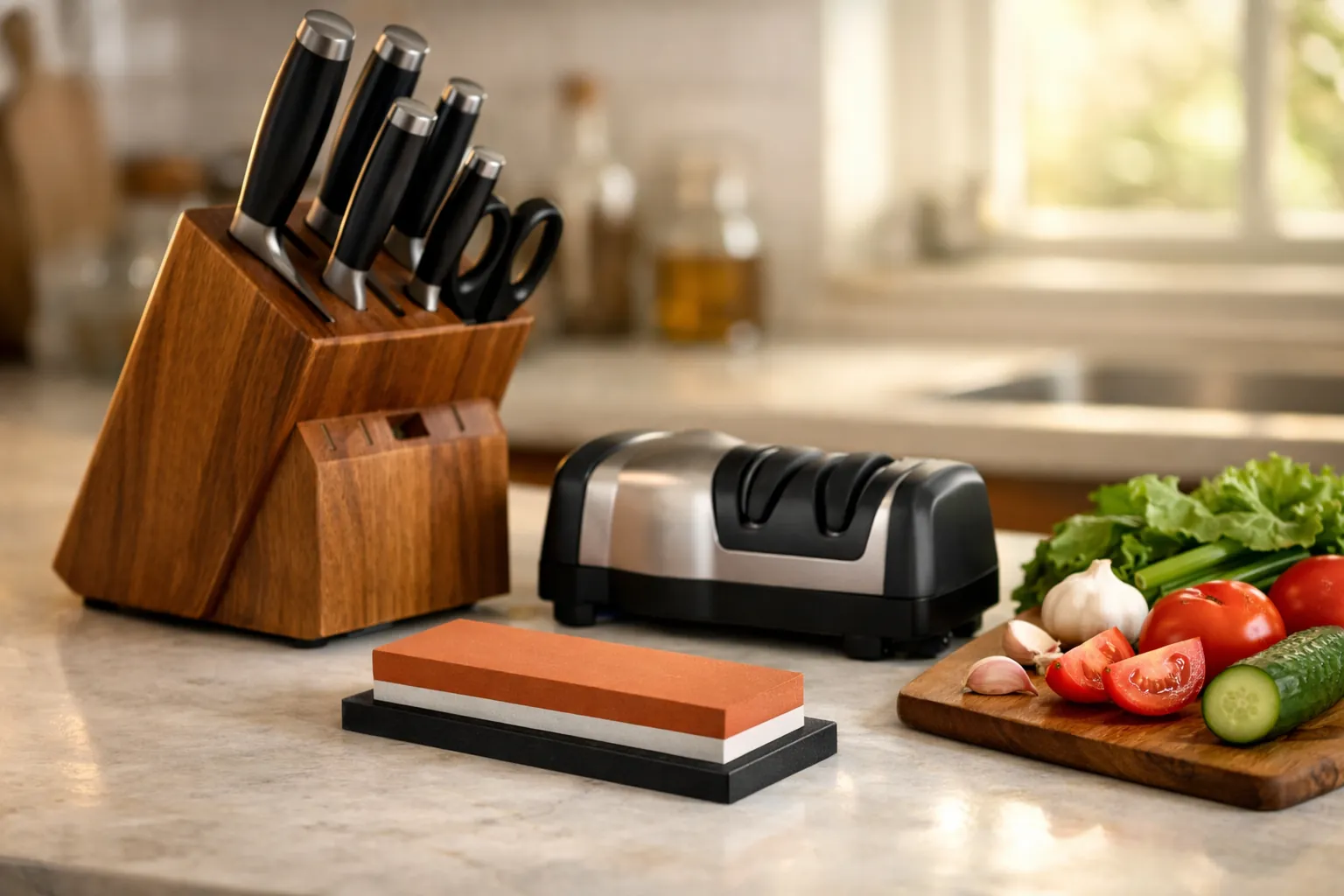
For most home kitchens, the best knife sharpener is the Chef'sChoice 15XV electric: it puts a consistent 15° edge on chef's, santoku and serrated knives in about a minute, with no skill. If you want more control, the Work Sharp Precision Adjust holds any angle from 15° to 30°. If you want the best edge and don't mind learning, a 1000/6000 whetstone is still unbeatable. Add a honing rod whatever you choose.
Quick picks
| Best overall for kitchen knives | Chef'sChoice 15XV EdgeSelect | Amazon |
|---|---|---|
| Best for precision without a learning curve | Work Sharp Precision Adjust | Amazon |
| Best edge quality | Sharp Pebble 1000/6000 Whetstone | Amazon |
| Best rolling sharpener | HORL 3 Cruise Rolling Sharpener | Amazon |
| Best pull-through for mixed knife sets | Zwilling 4-Stage Pull-Through | Amazon |
| Best for German knife owners | Wüsthof 2-Stage Hand-Held Sharpener | Amazon |
| Best budget pick | KitchenIQ Edge Grip 2-Stage | Amazon |
How we picked
- Kitchen-knife fit: handles 8-inch and longer chef's knives, covers German and Japanese angles, and ideally serrated knives.
- Evidence: Amazon ratings and "bought in the past month" counts on October 3, 2026. The Chef'sChoice 15XV showed 2,000+ purchases and 14,000+ ratings; the KitchenIQ Edge Grip nearly 98,000 ratings.
- Verified specs from each product's listing.
We research rather than test: picks come from listings, maker specs, owner feedback and standard sharpening practice. How we research.
Match the sharpener to your knives and effort
The 7 best knife sharpeners for kitchen knives
Chef'sChoice 15XV EdgeSelect
For a home kitchen, this is the sharpener most likely to keep knives sharp, because it's fast enough to use every week. Spring-loaded guides hold the knife at the angle, two diamond stages sharpen and hone, and a third flexible stage strops. Chef'sChoice says it converts typical 20° factory edges into 15° edges, which cut with less effort. It handles straight and serrated knives, and it's one of Amazon's best-selling electrics.
- Type3-stage electric
- Edge15°
- Abrasives100% diamond (stages 1-2), flexible stropping (stage 3)
- Kniveschef's, santoku, bread, serrated, more
- First sharpeningabout 1 minute (per maker)
Why it stands out
- Consistent edge in about a minute
- Serrated knives supported
- 14,000+ ratings
Think twice if
- You own single-bevel Japanese knives
- You want to keep a 20° edge on heavy-duty knives
Work Sharp Precision Adjust
If you'd like a stone-quality edge at exactly the angle your knife maker recommends, without learning freehand, this guided system is the answer. Set 15° for many Japanese knives or 20° for many German knives and sweep the abrasive along the edge. On long chef's knives, take extra care at the heel and tip, where reviewers have measured some angle drift.
- Typeguided clamp + arm
- Angle15° to 30°
- Abrasives320/600 diamond + fine ceramic
- Powernone
Why it stands out
- Any angle from 15° to 30°
- Gentle on good knives
Think twice if
- You want speed for a whole knife block
Sharp Pebble 1000/6000 Whetstone
A whetstone gives the most refined edge and removes the least metal, and this is the most popular kit on Amazon. Expect a few practice sessions; then a chef's knife takes 10 to 15 minutes. Our whetstone guide walks through it.
- Grits1000 / 6000
- Lubricantwater
- Includedbamboo base, angle guide
- Amazon rank#1 in Honing Stones
Why it stands out
- Works on every kitchen knife, including single-bevel
- Low cost
Think twice if
- You won't practice
HORL 3 Cruise Rolling Sharpener
A rolling sharpener is a pleasant middle ground: stick the knife to the magnetic block at 15° or 20° and roll the diamond disc along the edge, then the steel disc to remove the burr. HORL pitches the 15° side at Japanese and carbon blades and the 20° side at European chef's knives. It's quick, clean and looks good left out on the counter.
- Angles15° and 20°
- Discsdiamond + stainless honing
- Holdermagnetic angle support
- Waternone
Why it stands out
- Covers German and Japanese angles
- No water, minimal learning
Think twice if
- You need serrated knife support
Zwilling 4-Stage Pull-Through
If your block mixes German and Japanese knives, Zwilling's 4-stage puts coarse and fine slots for both Western and Asian-style blades in one compact handle. It's the simplest way to give each knife an appropriate angle without adjusting anything.
- Typemanual pull-through
- Stagescoarse and fine for Western blades, coarse and fine for Asian-style blades
- Basenon-slip
- Cleaningdamp cloth, not dishwasher safe
Why it stands out
- Separate Western and Asian slots
- From a major knife maker
Think twice if
- You want a refined, polished edge
Wüsthof 2-Stage Hand-Held Sharpener
Wüsthof's own handheld sharpener uses carbide wheels to set a dull edge and ceramic slats to refine it, at a preset angle. It's a quick, sensible option for owners of German knives who want something more substantial than a budget gadget. Use the ceramic side for routine touch-ups.
- Stagescarbide wheels (sharpen), ceramic slats (fine)
- Anglepreset
- Handleergonomic, non-slip base
Why it stands out
- Made by a German knife maker for its style of knife
- 3,600+ ratings
Think twice if
- You own Japanese knives
KitchenIQ Edge Grip 2-Stage
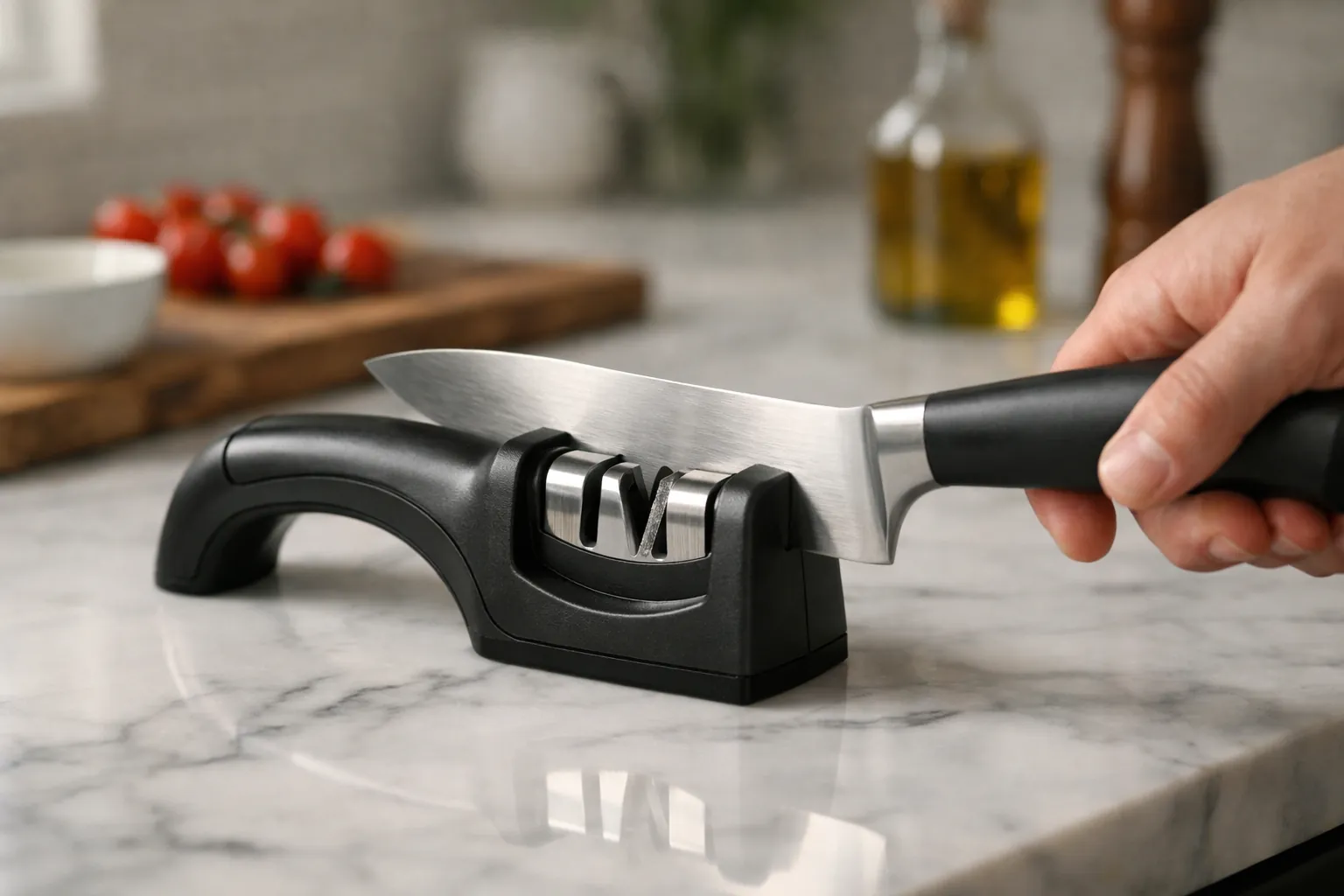
One of the most-reviewed knife sharpeners on Amazon, with nearly 98,000 ratings. It's cheap, tiny and fine for inexpensive knife sets. The V-notch lets it sit over the counter edge so a long blade's tip doesn't drag.
- Stagescarbide (coarse) + ceramic (fine)
- Knivesstraight and serrated
- Basenon-slip, counter-edge V grip
Why it stands out
- Very low cost
- Handles serrated knives
Think twice if
- You own good Japanese or premium knives
Side-by-side comparison
| Sharpener | Type | Angles | Serrated | Effort |
|---|---|---|---|---|
| Chef'sChoice 15XV | Electric | 15° | Yes | Lowest |
| Work Sharp Precision Adjust | Guided | 15°–30° | Listed | Moderate |
| Sharp Pebble 1000/6000 | Whetstone | Any | No | Highest |
| HORL 3 Cruise | Rolling | 15° / 20° | No | Low |
| Zwilling 4-Stage | Pull-through | Western + Asian slots | Check listing | Lowest |
| Wüsthof 2-Stage | Pull-through | Preset | Check listing | Lowest |
| KitchenIQ Edge Grip | Pull-through | Preset | Yes | Lowest |
Buying guide
German, Japanese, or both?
Many German and Western knives are sharpened around 20° per side and many Japanese knives around 15°. Check your knife maker's recommendation, and choose a sharpener that covers the angles you need; see the angle chart. Japanese-knife owners should read the best sharpeners for Japanese knives.
Serrated bread and steak knives
Not every sharpener handles serrations. If you need it, choose one that lists serrated knives, or see how to sharpen a serrated knife.
Coarse stages remove metal
Pull-through and electric sharpeners have aggressive first stages. Use them only when a knife is truly dull; use the fine stage for regular touch-ups so your knives last longer.
Which sharpener for which kitchen knife
| Knife | Good choices | Avoid |
|---|---|---|
| German chef's knife (Wüsthof, Zwilling style) | Electric, guided, whetstone, Wüsthof or Zwilling handheld | Nothing in particular; these are forgiving |
| Japanese gyuto or santoku | Whetstone, guided at 15°, rolling at 15°, 15° electric | Coarse carbide slots |
| Single-bevel (yanagiba, deba) | Whetstone | Electric, pull-through, most guided systems |
| Bread knife | Tapered rod, Sharpmaker, sharpeners listing serrated support | Flat stones on the scallops |
| Paring knife | Any of the above; short blades are easy | Over-grinding with coarse stages |
| Cleaver | Whetstone or guided at a higher angle | 15° settings, which are too thin for chopping |
| Ceramic knives | Diamond abrasives only (check the maker) | Steel rods, conventional pull-throughs |
Signs your kitchen knives need sharpening
- The knife slides off a tomato or pepper skin instead of biting in.
- You find yourself pressing down hard to cut carrots or onions.
- Herbs bruise and turn dark at the cut instead of slicing cleanly.
- Honing on a rod no longer brings the edge back.
A dull knife is also less safe: it needs more force and is more likely to slip. Most home cooks find a sharpening every few months, with honing in between, keeps knives in good shape.
The accessory that matters most: a honing rod
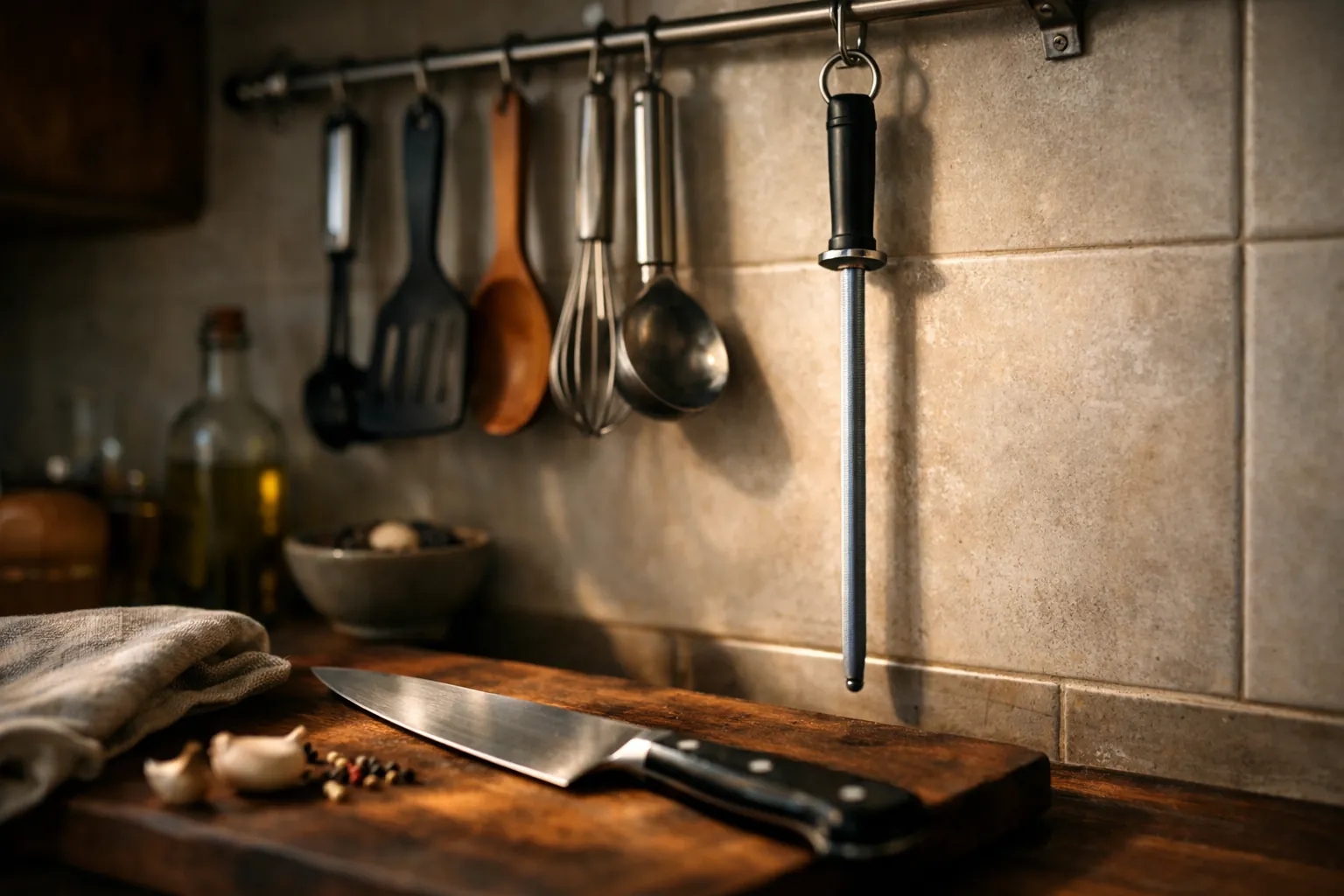
Honing every few uses straightens the edge and means you'll sharpen far less often. The Utopia Kitchen 12-inch honing rod is an inexpensive, popular steel rod with a hanging loop. See the best honing rods and honing rod vs whetstone.
The bottom line
The Chef'sChoice 15XV is the best knife sharpener for most kitchens. Choose the Work Sharp Precision Adjust for precise angles, the Sharp Pebble whetstone for the finest edge, and the KitchenIQ Edge Grip if budget matters most. More electric options are in the best electric knife sharpeners.
Specs, ratings and sales figures from Amazon listings checked October 3, 2026. We do not quote prices we have not checked. How we research · Affiliate disclosure